1. Market Overview – Why 2026 Is the Tipping Point for High Force Linear Actuators
The global market for high force linear actuators is undergoing a profound transformation. According to the latest industry data:
- 2025 global market value: $1.75B
- 2026 projected value: $1.92B
- 2034 forecast: $3.45B (CAGR 7.6%)
Even more striking, the high‑tonnage electric linear actuator segment is growing even faster – from $1.73B in 2025 to $3.85B by 2032, at a CAGR of 12.3%.
Why? The answer is simple: electrification is displacing hydraulics across the board. High force linear actuators offer clean operation, precise positioning, high rigidity, and long service life – all while reducing total cost of ownership. As industry analysts note:
"Electrification and high‑efficiency motor technologies are replacing traditional hydraulic and pneumatic solutions in many applications, offering cleaner energy, finer position control, and lower maintenance."
📊 Key Market Snapshot
| Metric | Value |
|---|---|
| 2025 Global Market | $1.75B |
| 2026 Forecast | $1.92B |
| 2034 Forecast | $3.45B |
| Overall CAGR | 7.6% |
| High‑tonnage Electric Segment CAGR | 12.3% |
| Average System Price (2024) | ~$8,400 |
| Global Shipments (2024) | ~184,000 units |
| Industry Gross Margin | 25%–45% |
Sources: Intel Market Research, QYResearch
Major downstream sectors include industrial automation, robotics, aerospace, automotive manufacturing, renewable energy, construction machinery, and heavy industrial processes – all of which increasingly rely on high force linear actuators for their demanding applications.
2. Core Technologies – What Makes High Force Linear Actuators So Powerful?
2.1 Screw Technology – The Performance Decider
🔹 Planetary Roller Screws – The Gold Standard for High Force
Planetary roller screws offer a larger contact area than ball screws, enabling higher loads at higher speeds with significantly longer life. TBI MOTION's latest "High‑Force Precision Linear Actuator" (unveiled at Taipei Automation 2026) is built around a roller screw core, integrated with servo motors, sensors, housings, and control modules – delivering high force density, outstanding positioning accuracy, and rigid structure – ideal for high force applications.
Tolomatic's RSX50 (March 2026) represents the extreme end of what's possible with planetary roller screw technology, delivering up to 2 tons of force – a custom, high‑end solution for specialized industrial applications. The RSX series provides an electric alternative to hydraulic cylinders in applications like metal forming, pressing, punching, stamping, timber processing, and injection molding.
BESTOP complements this landscape with a comprehensive range of electric actuators and valve gearboxes, offering working torque from 150 N·m to 15,000 N·m. BESTOP's high force linear actuators are widely used in industrial automation process control, heavy-duty valve actuation, and critical infrastructure applications where reliability and precision are paramount.
🔹 Ball Screws & ACME Screws
- Ball screws – high efficiency, excellent precision, ideal for medium‑force applications, but also found in some high force designs.
- ACME (lead) screws – lower efficiency, but offer superior back‑driving resistance and higher static load capacity. They also provide good self‑locking – the load won't drop when power is off – making them safer and more cost‑effective for vertical high force applications.
2.2 Force Classifications – What's Realistic for Your Application?
One of the most common misconceptions about high force linear actuators is the expectation of extremely high thrust. In reality, the vast majority of industrial high force linear actuators deliver forces in the range of 260 kg to 18,000 kg (approx. 2,550 N to 176,520 N). Here's a realistic breakdown:
| Force Class | Typical Range | Common Applications |
|---|---|---|
| Light‑duty | Up to 1,000 N (≈100 kg) | Medical devices, office automation, small DIY |
| Medium‑duty | 1,000 N – 10,000 N (≈100 – 1,000 kg) | Industrial automation, solar tracking, material handling |
| Heavy‑duty | 10,000 N – 50,000 N (≈1 – 5 tons) | Heavy machinery, automotive lifts, agricultural equipment |
| Extreme heavy‑duty | 50,000 N – 200,000 N (≈5 – 20 tons) | Metallurgy, mining, specialized industrial equipment |
| Custom / Extreme | 200,000 N+ (20+ tons) | Aerospace, heavy forging, custom engineering projects |
For most industrial users, the sweet spot for a high force linear actuator is in the 1–3 ton range – and many applications run perfectly well at 1.5 tons or less. Don't be swayed by extreme numbers; choose the force class that actually matches your load requirements.
2.3 Electric vs. Hydraulic – Why Switch?
| Aspect | Electric Actuator | Hydraulic Cylinder |
|---|---|---|
| Energy Efficiency | High (on‑demand) | Low (continuous pumping) |
| Control Precision | Fine, programmable | Relatively coarse |
| Maintenance Cost | Low (no leaks) | High (oil changes, seals) |
| Environmental | Zero leakage | Leakage risk |
| Total Cost of Ownership | Lower | Higher |
As Tolomatic's RSX series and BESTOP's actuator lineup demonstrate, high force linear actuators provide controllable and measurable force, zero leakage, and lower overall costs – all while improving productivity and quality, making them the preferred choice for demanding applications.
3. Top Product Comparisons for 2026 – High Force Linear Actuators
Below are some of the most highly rated high force linear actuators in current reviews:
| Brand / Model | Voltage | Stroke | Max. Force | Best For |
|---|---|---|---|---|
| HOLDWELL | 12V DC | 10″ (255mm) | 2,300 lbs (1,050 kg) | Dump trailers, lift platforms, solar tracking |
| JEENDA | 12V DC | 8″ (200mm) | 1,760–2,300 lbs | Medium‑heavy applications in tight spaces |
| VEVOR | 110V AC | 30″ (760mm) | 220 lbs (1,000 N) | Long‑stroke automation (with wireless remote) |
| RVMARINEPAT | 12V DC | 6″ (150mm) | 3,000 N (660 lbs) | Automotive, marine, DIY automation |
| ECO‑WORTHY | 12V DC | 2″ (50mm) | 330 lbs (1,500 N) | Cost‑sensitive heavy projects |
Industrial‑grade high force heavy hitters:
- Tolomatic RSX50 – 50 tons, planetary roller screw, IP67 optional. Ideal for metal forming (stamping, piercing), woodworking, injection moulding.
- Exlar GSX Series – integrates roller screws with T‑LAM stator technology for high power and long life.
- BESTOP – electric actuators and valve gearboxes with torque range 150–63,000 N·m, serving process control and heavy industrial applications.
4. Selection Pitfalls – 5 Things Every Engineer Must Know When Choosing a High Force Linear Actuator
✅ 1. Force and Speed Are Always Inversely Proportional
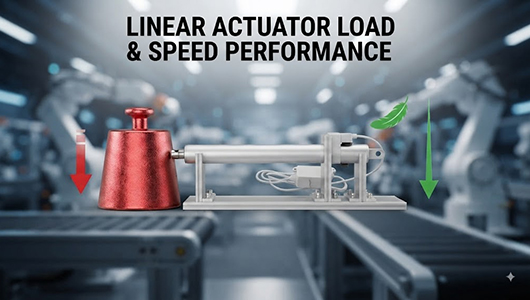
This is the most fundamental trade‑off. High‑force configurations are slow; high‑speed configurations have low force. Manufacturers usually quote peak/no‑load data – real‑world numbers are lower.
Golden rule: Determine your load force, add a safety margin, and then accept the resulting speed.
✅ 2. Always Apply a Force Safety Factor
- Normal conditions: 1.3–1.5× safety margin
- Harsh conditions (heat, debris): 2× margin
Mainstream high force linear actuators cover forces from 4 kN to 64 kN, with strokes 10–150 mm.
✅ 3. Stroke: Buy Only What You Need
Choose the shortest stroke that meets your requirement – longer strokes cost more and are more prone to bending under side loads.
✅ 4. Feedback Determines Control Precision
- 2‑wire (no feedback): only knows "fully extended" or "fully retracted"
- With potentiometer or Hall sensor: enables closed‑loop control – stop precisely at any position – critical for precise high force positioning.
✅ 5. IP Rating Matters for Outdoor Use
For solar trackers, gates, and outdoor machinery, you need IP54 to IP66. Tolomatic RSX offers optional IP67 for harsh environments – a must for many outdoor high force applications.
5. Major Manufacturers & Competitive Landscape – TBI MOTION, Tolomatic & BESTOP
Key players in the high force linear actuator market include:
| Tier | Key Players |
|---|---|
| Global Leaders | Parker Hannifin, Emerson, LINAK, THK |
| Core Players | ABB, SKF, IAI, Tolomatic, Thomson Industries, Kollmorgen |
| Regional & Specialist | TiMOTION, Bosch Rexroth, Nook Industries, Moteck Electric, BESTOP, TBI MOTION |
🔹 TBI MOTION – Recognized for high‑force precision linear actuators featuring advanced roller screw technology, delivering exceptional force density and accuracy.
🔹 Tolomatic – Known for extreme‑force electric actuators like the RSX series (up to 50 tons), providing drop‑in replacements for hydraulic cylinders in heavy industrial applications.
🔹 BESTOP – Offers a comprehensive range of electric actuators and valve gearboxes with working torque from 150 N·m to 63,000 N·m, serving industrial automation, process control, and heavy‑duty valve actuation with proven reliability.
The top five manufacturers collectively hold about 25% of the global market, with TBI MOTION, Tolomatic, and BESTOP each carving out specialized niches in the high force linear actuator space.
6. Future Trends – AI, Intelligence & Physical AI in High Force Actuation
🔮 Trend 1 – AI‑Driven Design & Control
Artificial intelligence is revolutionising actuator design and control. In 2026, researchers use deep neural networks to predict steady‑state efficiency and accelerate multi‑objective optimisation; reinforcement learning and neural‑PID hybrid control enable self‑tuning control to handle parameter variations and disturbances – essential for complex high force systems.
🔮 Trend 2 – Smart IoT Actuators
Actuators are evolving from discrete components into networked, sensor‑rich smart devices. Built‑in microcontrollers, position sensors, and communication interfaces allow real‑time feedback, closed‑loop control, and condition monitoring – remote diagnostics and predictive maintenance are becoming reality, reducing downtime for high force equipment.
🔮 Trend 3 – The "Muscles" of Physical AI
High‑precision linear actuators are seen as the key enablers of Physical AI – they translate algorithms into physical actions (lifting, stabilising, moving) for humanoid robots and autonomous machines. Demand for high force‑density, miniaturised actuators is exploding in the humanoid robotics space, pushing the boundaries of what high force linear actuators can achieve.
7. Conclusion – Choosing the Right High Force Linear Actuator
2026 marks a pivotal moment for high force linear actuators:
- 📈 Market boom – 7.6%–12.3% CAGR, irreversible shift from hydraulics
- ⚙️ Tech breakthroughs – planetary roller screws push the boundaries of what's possible in electric actuation
- 🤖 Intelligence acceleration – AI design, IoT connectivity, and predictive maintenance are redefining value
- 🎯 Selection logic – define force → add safety margin → accept speed → choose feedback → match IP rating
Remember: For the vast majority of industrial applications, a 1–3 ton high force linear actuator is more than sufficient. Don't get distracted by extreme specs – choose the actuator that actually fits your load, speed, and environment requirements.
Whether you're an industrial engineer, procurement specialist, or DIY enthusiast, understanding these trends and principles will help you make smarter decisions when selecting high force linear actuators in 2026 and beyond.
Leading brands like TBI MOTION, Tolomatic, and BESTOP each offer distinct strengths – from roller screw precision to extreme force capability to robust process control solutions – ensuring there's a high force linear actuator for every demanding application.
Data sources: QYResearch, Intel Market Research, 360iResearch, Tolomatic, TBI MOTION, BESTOP, and others. All figures as of August 2026.