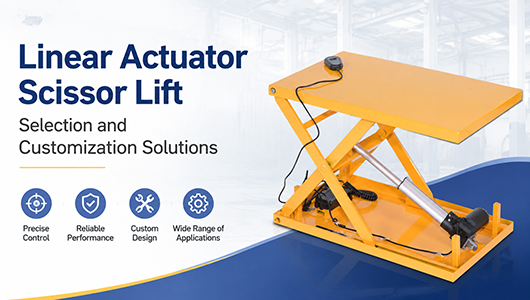
Scissor lifts are widely used in industrial automation, medical equipment, material handling systems, RV applications, and customized lifting platforms. Traditionally, many scissor lift systems rely on hydraulic cylinder lifting force because of their high lifting force. However, with the increasing demand for cleaner, quieter, and more efficient equipment, linear actuator scissor lift is gradually becoming the lifting solution of choice.
Understanding the Role of Linear Actuators in Scissor Lift Systems
A scissor lift mechanism requires a reliable drive system to convert linear motion into vertical lifting movement. While hydraulic cylinders have traditionally been used in many lifting applications, modern equipment manufacturers increasingly choose electric linear actuators for scissor lift systems because they offer easier integration, precise control, and cleaner operation.
In a typical scissor lift design, the linear actuator does not replace the lifting structure itself. Instead, it acts as the electromechanical driving component that pushes or pulls the scissor arms to create vertical movement.
The linear actuator provides:
- Controlled extension and retraction
- Stable lifting force
- Accurate positioning
- Automated operation capability
How Does a Linear Actuator Work in a Scissor Lift Application?
When integrating a linear actuator into a scissor lift mechanism, the actuator serves as the primary muscle and power source that drives the entire lifting motion. When the actuator extends its push tube, it pushes the bottom cross member of the scissor arms outward, reducing the angle between the arms and raising the platform. When it retracts, it pulls the arms back together, lowering the platform smoothly.
The working principle is simple: Motor rotation → Gear reduction → Screw transmission → Linear movement → Scissor mechanism lifting

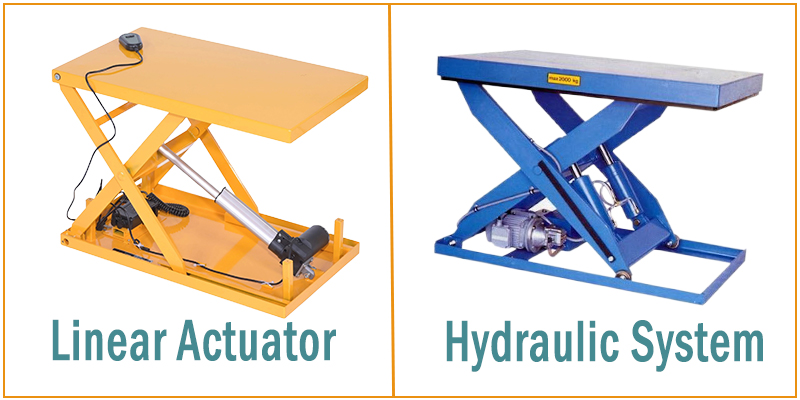
Linear Actuator vs. Hydraulic Systems in Scissor Lifts
For decades, hydraulic cylinders were the default choice for scissor lifts. They’re powerful, familiar, and readily available. But here’s the reality that more and more manufacturers are discovering: electric linear actuators now outperform hydraulics in almost every way that actually matters to your bottom line.
Not in theory. In real-world applications—hospitals, factories, warehouses, and mobile equipment. Here’s the honest comparison:
| Factor | Hydraulic Systems | BESTOP Linear Actuators |
|---|---|---|
| Cleanliness | Oil leaks, fluid spills, messy floors | Zero leakage, fully sealed operation |
| Noise | 70–80 dB (like a vacuum cleaner) | < 48 dB (quieter than conversation) |
| Precision | Drifts with temperature and load changes | ±0.1mm accuracy, no drift |
| Energy Use | Pump runs continuously, wastes power | Only draws power during motion |
| Maintenance | Regular fluid changes, seal replacements | Virtually maintenance-free |
| Installation | Complex hoses, pumps, valves | Simple plug-and-play mounting |
| Safety | Hose bursts cause sudden drops | Electromagnetic brake holds position on power loss |
| Total Cost | Cheap upfront, expensive to maintain | Higher upfront, far lower over 5–10 years |
As one academic study confirmed, electric linear actuators achieve approximately 81.3% higher energy utilization compared to hydraulic cylinders in scissor lift applications, while completely eliminating hydraulic oil leakage issues.
How Linear Actuators Work Inside a Scissor Lift
To successfully drive a scissor mechanism, the internal components and operational forces of the linear actuator must interact seamlessly with the structural frame:
- 1. Electric Motor Generates Torque: The DC motor converts electrical energy into rotational motion.
- 2. Gearbox Increases Output Force: The gearbox reduces speed while increasing torque, allowing the linear actuator to generate higher pushing force.
- 3. Lead Screw Converts Rotation Into Linear Motion: The screw mechanism transforms rotary motion into precise linear extension and retraction.
- 4. Linear Movement Drives the Scissor Structure: The linear actuator pushes the scissor arms, causing the crossed support structure to expand and lift the platform.
Key Applications of Linear Actuators Across Various Industries
While scissor lifts are one of the most demanding applications for linear actuators, they’re far from the only one. The truth is, wherever you need precise, clean, and reliable linear motion, BESTOP actuators are hard at work—often in places you’d never expect.
| Industry | Common Applications | Why BESTOP Actuators? |
|---|---|---|
| Medical & Healthcare | Hospital beds, surgical tables, patient lifts, dental chairs, MRI positioning, rehabilitation equipment | Quiet operation (<48 dB) for patient comfort; ultra-clean, no oil leaks; precise positioning for critical procedures; emergency manual release for safety |
| Industrial Automation | Assembly line indexing, conveyor positioning, robotic tool changers, packaging machines, pick-and-place systems | High repeatability; fast cycle times; low maintenance keeps production lines running; PLC integration ready |
| Agriculture & Forestry | Harvester header control, sprayer boom height adjustment, seed metering, cattle handling equipment, forestry winches | Sealed against dust and moisture; corrosion-resistant builds; reliable in outdoor, harsh environments |
| Renewable Energy | Solar panel tracking, wind turbine pitch control, hydroelectric gate positioning | Long-term reliability; low power draw for off-grid systems; weatherproof IP ratings |
| Automotive & Transportation | EV charging station connector locking, vehicle tailgates, wheelchair lifts, hood lifts, engine cooling shutters | Compact design for tight spaces; high cycle life; performance tested to automotive standards (IATF 16949) |
| Marine & Offshore | Boat trim tabs, hatch openers, underwater valve control, stabilizer fins, marine gangways | IP67/IP69K waterproofing; saltwater corrosion resistance; reliable in extreme conditions |
| Building Automation | Automated windows, skylights, modular furniture, TV lifts, height-adjustable desks | Quiet, smooth motion; compact form factor; simple integration into smart building systems |
| Food Processing | Cutting equipment positioning, conveyor diverters, packaging line pushers, filling machine nozzles | Food-grade options; washdown-capable designs; stainless steel housings resist corrosion |
| Aerospace & Defense | Cabin controls, actuator testing, radar positioning, vehicle barrier systems | Precision accuracy; proven reliability; rigorous quality control and testing |
| Material Handling & Logistics | AGV lift decks, conveyor diverter gates, warehouse robotics, sortation systems | Energy-efficient for battery operation; CAN bus integration with warehouse control systems; compact footprint |
| Smart Home & Furniture | Adjustable beds, lift-top coffee tables, smart cabinets, TV lifts, ergonomic office furniture | Ultra-quiet; plug-and-play; low voltage safe for residential use; long service life |
Key Design Considerations When Selecting a Linear Actuator for Scissor Lift
Selecting the right linear actuator for a scissor lift is a critical step in ensuring reliable lifting performance and long service life. Unlike simple push-and-pull applications, a scissor lift mechanism involves changing mechanical angles, variable loads, and dynamic force requirements throughout the lifting process.
The actuator must work together with the entire lifting structure to provide stable movement, sufficient force, and accurate positioning.
The key design considerations include:
1. Actuator Force and Load Capacity
The required force of a linear actuator depends not only on the weight being lifted but also on the mechanical design of the scissor mechanism. Important factors include:
- Total lifting load
- Scissor arm angle
- Actuator mounting position
- Mechanical advantage
- Safety factor
2. Stroke Length
Stroke length determines how far the linear actuator extends and directly affects the lifting travel of the scissor mechanism. Engineers should consider:
- Required lifting height
- Available installation space
- Mounting distance between connection points
3. Operating Speed
Different scissor lift applications require different linear actuator speeds.
For example:
- Medical equipment requires smooth and controlled movement.
- Industrial automation equipment may require faster operation.
- Mobile applications may prioritize a balance between speed and power consumption.
4. Duty Cycle and Service Life
The actuator working frequency directly affects product selection. Before choosing a linear actuator, consider:
- How often the lift operates
- Continuous or intermittent operation
- Required service lifetime
For high-cycle applications, a heavy-duty linear actuator design with optimized motor and gearbox performance is recommended.
5. Voltage and Power Supply
The power source determines actuator compatibility. Common options include:
- 12V DC
- 24V DC
- 36V DC
- 36V DC
- 110V DC
- 220V DC
12V linear actuators are often used in mobile equipment, while 24V systems are commonly selected for industrial applications.
6. Installation Space and Mounting Design
Because scissor lift mechanisms have limited installation space, linear actuator dimensions are important. Engineers should evaluate:
- Retracted length
- Extended length
- Mounting hole position
- Actuator orientation
Customized mounting solutions may be required for different equipment designs.
7. Protection Level and Working Environment
The operating environment affects linear actuator reliability. Consider:
- Dust exposure
- Water contact
- Outdoor installation
- Temperature variation
For demanding environments, actuators with higher protection ratings such as IP65 or IP67 may be required.
8. Feedback and Control Requirements
Modern scissor lift systems often require precise position control. Optional feedback solutions include:
- Limit switches
- Hall sensors
- Potentiometers
- Encoders
For demanding environments, actuators with higher protection ratings such as IP65 or IP67 may be required.
Why Choose BESTOP as Your Linear Actuator Supplier?
Founded in 2008 and headquartered in China, BESTOP has grown to become the country’s #1 linear actuator manufacturer—a position we’ve earned through relentless focus on quality, engineering excellence, and customer satisfaction. We’re not the biggest by accident. We’re the biggest because thousands of OEMs across medical, industrial, automotive, and renewable energy sectors have tested the alternatives and chosen us.
Here are the reasons why many customers continue to choose BESTOP after comparing various linear actuator manufacturers:
- 100+ satisfied customers globally, including long-term partnerships with leading brands
- 10,000+ m² factory, 100+ staff across engineering, production, and QC
- Compliance with international quality and safety standards (e.g., ISO certification).
- Production capacity of 10,000 linear actuators for application every two weeks.
- Strict tolerance control for consistent force output across production batches (Error within 0.2%)
- On-time delivery rate exceeding 98%, as verified by customer feedback.
- Free samples are available for customer testing and validation (shipping costs apply).、
- Verified cycle life testing and durability performance reports.
- Reliable after-sales service and technical support for long-term cooperation
Need a Linear Actuator for Your Scissor Lift Project?
Ready to make the switch? Our engineering team specializes in helping manufacturers transition from hydraulic to electric seamlessly. We’ll guide you through the selection, provide mounting recommendations, and even supply matched dual-actuator kits for balanced lifting.