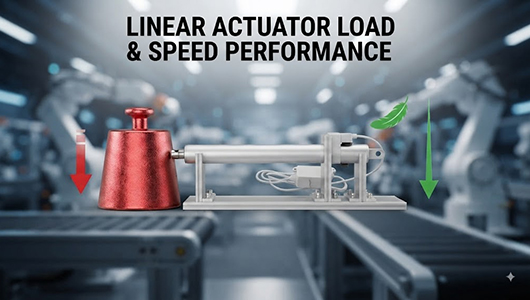
“We bought a 200 mm/s fast linear actuator, but on our line it barely does 120.” – That’s the most common complaint we hear from automation engineers.
Today we show you why that happens, and how to choose a truly fast linear actuator – one that keeps its promise under real load.
Why Your Fast Linear Actuator Slows Down Under Load Force
Let’s start with a fact most suppliers hide: the speed printed on the first page of every datasheet is measured with zero load – no fixture, no workpiece, no friction. It’s a lab number, not a real-world guarantee.
Once you add load force, three physical effects kick in:
-
Motor current rises: Increasing copper loss and reducing RPM.
-
Back-EMF increases: Limiting the maximum speed.
-
Screw friction grows: Especially under thrust.
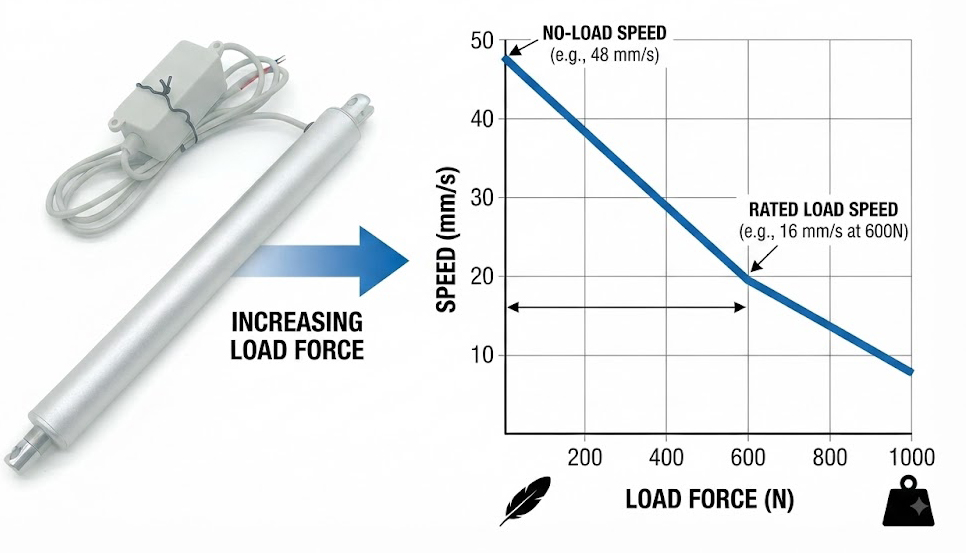
The result? A linear drop in speed as load increases. In our tests, many “fast” actuators lose 30~50% of their no-load speed when operating at 50% of their rated force.
That’s why a smart selection never starts with the max speed – it starts with your actual load.
How to Read Speed‑Force Curve for Fast Linear Actuator
The linear actuator speed-force curve is the single most important document you must request from every supplier. It plots speed (mm/s) against load force (N) and tells you exactly what performance to expect at your working point.
BESTOP Fast Linear Actuator Case Studies
| Load Force (N) | Measured Speed (mm/s) |
|---|---|
| 0 (no load) | 200 |
| 50 | 183 |
| 100 | 167 |
| 150 | 149 |
| 200 | 136 |
| 250 | 120 |
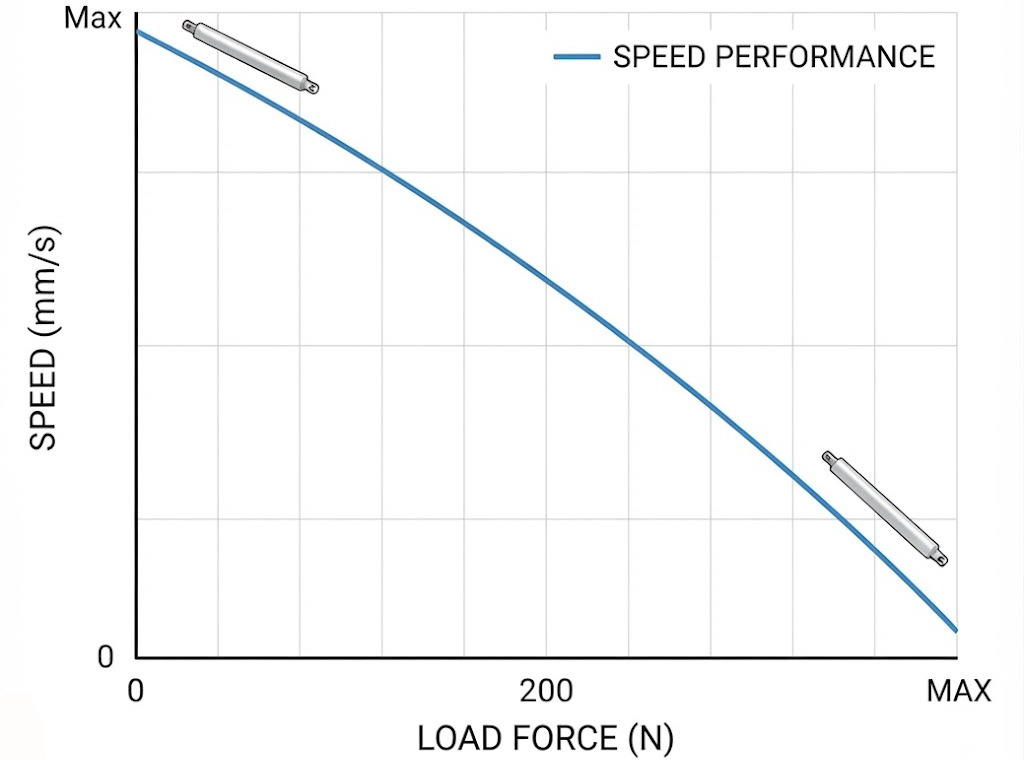
At 200 N, this fast linear actuator delivers 136 mm/s – not the 200 mm/s you might have wrongly used for cycle time calculations. Always use the speed value at your specific load to size your machine.
Two Curve Shapes That Reveal Fast Linear Actuator Quality
| Curve Type / Slope | What It Means | Application |
|---|---|---|
| Gentle decline (≤15% drop from 0 to rated load) | ✅ Good design – motor and screw well matched | Suitable for high-speed applications |
| Steep cliff (>30% drop) | ❌ Under-sized motor or over-sized lead – avoid | Will disappoint under real work |
Pro tip: Ask the linear actuator supplier: “Is this curve measured or calculated?”
If they say “calculated” or cannot show raw data points – they haven’t tested it. That is a red flag.
Hidden Factors That Kill Linear Actuator Speed Performance
Even with a perfect curve, your fast linear actuator may underperform because of these often-overlooked issues.
| Hidden Factor | Why It Affects Speed | What to Ask Your Supplier |
|---|---|---|
| Voltage sag | Speed ∝ voltage. A 24V supply dropping to 22.5V costs approximately 6% speed. | "Speed variation at ±10% voltage?" |
| Duty cycle & temperature | High speed = high heat. As motor heats, resistance rises → speed drops. | "Show me the temperature-rise curve at 100% duty cycle." |
| Acceleration time | For short strokes, slow acceleration eats more cycle time than top speed. | "Acceleration time from 0 to rated speed under load?" |
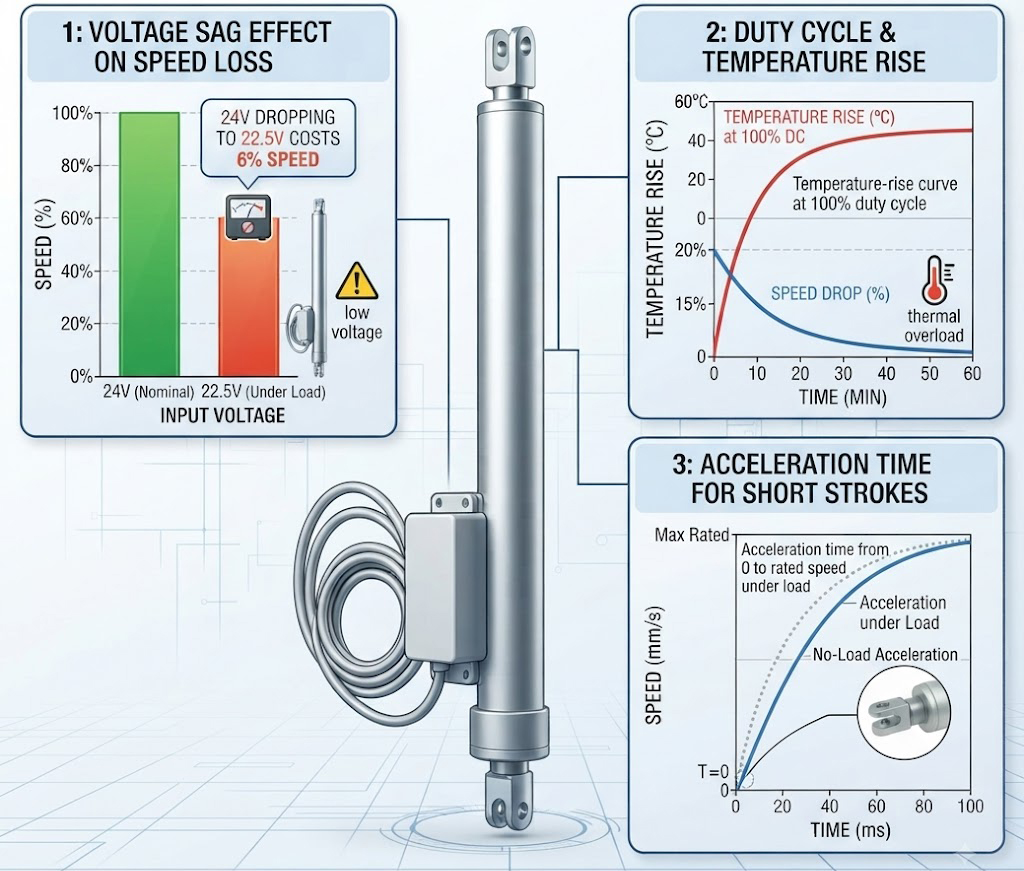
BESTOP tests every high-speed model at 5 load points × 3 voltage levels × 2 duty cycles – generating over 30 data points per actuator. We share the raw test reports, not just a polished brochure.
Fast Linear Actuator Selection Checklist – 5 Steps to Guarantee Real Speed
Use this checklist to avoid buying a “paper-fast” linear actuator:
| Step | Action | Why This Matters |
|---|---|---|
| 1 | Define your real working load (include fixture + 20% safety margin) | Sets the correct baseline |
| 2 | Request the measured speed-force curve (raw data preferred) | Gives you the true speed at your load |
| 3 | Re-calculate your cycle time using the load-speed value, not no-load speed | Prevents over-promising on throughput |
| 4 | Verify duty cycle and ask for continuous-run speed data | Ensures performance doesn’t degrade after 10 minutes |
| 5 | Ask for a test video or a demo unit under your specified load | See it with your own eyes – ultimate trust builder |
How BESTOP Delivers Trustworthy Speed Data
As China’s No.1 linear actuator manufacturer with over 20 years of experience, we don’t just claim speed – we prove it.
-
Expertise: Our R&D team has designed over 500 custom high-speed actuators for industries from medical devices to packaging automation.
-
Experience: We test every model on a dynamometer for 200+ continuous hours to verify speed stability under heat.
-
Authoritativeness: Our speed-force curves are third-party witnessed and we supply the raw logged data upon request.
-
Trustworthiness: We offer a sample loan program – we ship you a demo unit, you run it on your bench with your load, and only then you decide.
We don’t ask you to trust a number. We ask you to trust evidence.
Ready to Select a Fast Linear Actuator That Delivers Real Speed?
Stop guessing. Stop relying on optimistic datasheets.
Send us your load, stroke, and required cycle time – our engineers will reply within 24 hours with:
-
A personalised speed-force projection: Tailored specifically for your exact application requirements.
-
The actual measured curve: Provided directly from the testing of the recommended model.
-
A video clip (if available): Showcasing the actuator running smoothly under similar conditions.